





For six years, nearly every meal in our house started on a white plastic cutting board, and whenever one warped I bought another just like it.
I chopped on it every day. Onions, chicken, the kids' apples. One night I was wiping it down, ran my thumbnail along a groove in the middle, and a little curl of white plastic came up under my nail.
That bothered me enough to go reading, and I found a 2023 study on plastic cutting boards. The researchers chopped on polyethylene and polypropylene boards and found microplastics coming off them during chopping. I flipped ours over to check the stamp on the back. Polypropylene.
The amount depended on the board material and how the chopping was done, and the yearly totals in the paper were estimates built on assumptions. I didn't need an exact number for my kitchen.
Every one of those grooves was a spot where the knife had taken a sliver of board with it, and I'd been cutting our dinner on top of that for years.
Once I'd seen it, I wanted that board gone. We cook at home almost every night, so that board touched nearly everything we ate.
That's how I ended up with a titanium cutting board from Okura, which I've now used for every meal for a little over a month.
What My Knife Was Doing To Our Plastic Boards Every Night

Plastic is soft enough that a sharp knife bites into it a little with every cut. That's why old boards turn fuzzy and scarred in the middle.
Those scars are places where the board has worn away, and the 2023 research suggests some of that material ends up in the food you're preparing.
The study tested two common board plastics and found that both released microplastics while food was being chopped.
How much came off varied with the type of plastic and how the chopping was done in each test.
My first thought was a wooden board, and my sister, who has owned a few, told me what that really involves:
It soaks up water. Wood absorbs moisture, so it needs careful drying after every wash, and for many boards occasional oiling to keep it in good condition.
Damp is a problem. Leave it wet for too long and it can start to smell, grow mold or begin to rot.
Soaking wrecks it. Repeated soaking can crack or warp a wooden board, so it can't sit in the sink with the dishes.
Wood is still a good plastic-free choice, and it's gentler on knife edges. I just know myself. I was never going to oil a cutting board, or dry it properly every single time.
So I wanted something plastic-free that I could wash, dry and put away like a plate.
Titanium kept coming up in my reading. It's a metal cutting surface, so there's no plastic layer for the knife to wear down and no wood fibers to soak up water.
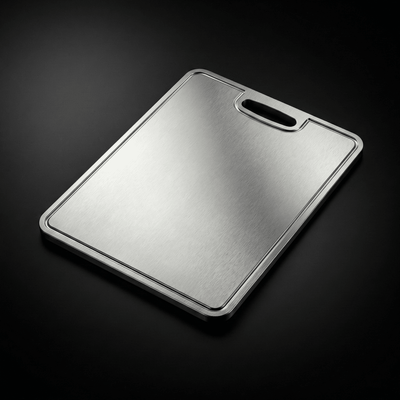
The one I picked was the Okura titanium cutting board in the medium size, 36 × 25 cm.
Okura sells it direct, which mattered to me once I noticed how many cheap listings pass off stainless steel as titanium.
It also had a 4.8 out of 5 rating from more than 15,500 reviews, which made the price easier to swallow.
My First Week Chopping On A Sheet Of Titanium

I started using the Okura board the night it arrived, for a weeknight stir-fry.
It's slim, with a handle opening at the top so I can lift it with one hand, and the surface has a fine texture to it.
There was a small learning curve. Titanium is harder than wood or plastic, so I stopped scraping chopped food across it with the knife edge. I flip the knife and push things along with the spine.
What I like most is how little it asks of me. It was made for everyday prep with none of the upkeep I'd been dreading.
The details that matter day to day:
A plastic-free cutting surface. It's solid titanium where the knife meets the food.
Nothing soaks in. The surface is non-porous and doesn't absorb water, which was my whole problem with wood.
Easy cleanup. Warm water and dish soap, then a rinse and a dry. Okura's care instructions say it needs no oiling or wood conditioning, which is exactly the routine I wanted.
Three sizes. Small (29 × 20 cm) for quick jobs, Medium (36 × 25 cm) for everyday prep and Large (46 × 30 cm) when you need room. There's also a set with all three.
25-year warranty. Okura backs the board with a 25-year warranty under its terms, and shipping is free.
By the end of that first week, cleanup was the part I noticed most. It takes about a minute, and nothing soaks into it. I wash it, dry it with a towel and it's back on the counter before the pan has cooled.
I've also stopped wondering what's coming off the board while I'm cutting up the kids' fruit.
Titanium is a harder surface than wood, so I hone my knives a bit more often and never drag the edge across it. Okura is upfront about that, which made me trust the rest of what they say.
I still think about that curl of plastic under my nail every time I make dinner.
What Changed In Our Kitchen After A Month On Titanium

Switching to the Okura board took about two minutes. The old plastic boards went in the trash and the titanium one took their spot by the stove.
Looking back, I'd spent years scrubbing stained grooves and replacing warped boards.
Most of that is gone now.
After a month with Okura, the everyday differences are easy to list:
No plastic on the cutting surface. The study that started all this measured microplastics coming off plastic boards during chopping. Our board has no plastic left to cut into.
Cleanup in about a minute. Warm water, dish soap, a rinse and a towel. Non-porous doesn't mean self-cleaning, so I still wash it properly between raw chicken and salad.
Skip the oil and the drying rack. It doesn't absorb water, so there's no wood to condition and no leaving it propped up overnight to dry.
It stays out on the counter. It's slim, it has a handle opening and it looks tidy enough that I don't bother hiding it in a cupboard.
Honest knife wear. My knives are fine, and I keep them that way by honing more often and never dragging the edge across the board. If keeping a perfect edge is your top priority, wood is gentler.
Knife marks over time. Visible knife marks show up with use, the same as on any board. There's no coating on it to chip or flake off.
One board for years. It comes with Okura's 25-year warranty under its terms, which is more than any plastic board I've owned could say.
What Other Families Say After Ditching Their Plastic Boards
Plenty of other home cooks have made the same swap.
A few of their posts:


 Like
 Comment


My Verdict After A Month: The Plastic Boards Aren't Coming Back
I've used the Okura board for every meal for over a month now, and I'd buy it again.
Cleanup is quicker, and I've stopped thinking about what's coming off the board and into dinner.
It comes with a 25-year warranty and free shipping, and it has taken the place of the plastic boards I kept rebuying.
If your boards look anything like my old one, take a look at the Okura titanium cutting board and see which size suits your kitchen. The Restock Sale price is on now.
Order it from Okura's own website. There are stainless steel boards out there sold as titanium, and buying direct is the easy way to avoid them.
Click here to check today's price on the Okura Titanium Cutting Board and save 55% in the Restock Sale.
As of October 12, 2026, the Restock Sale is live. The Small board is $89.95, down from $200.00, with free shipping and Okura's 25-year warranty.
NOTE: Buy direct from Okura Cookware to get genuine titanium.
Customer Ratings
Average based on 15,500+ reviews
 Excellent


